In the automotive repair industry, real authority is rarely theoretical. It’s built in workshops, under pressure, where precision matters and mistakes are visible immediately. You either know what you’re doing… or the result shows. That’s why, when it comes to evaluating excellence in this field, organizations tend to rely on professionals who have spent years inside the process itself.
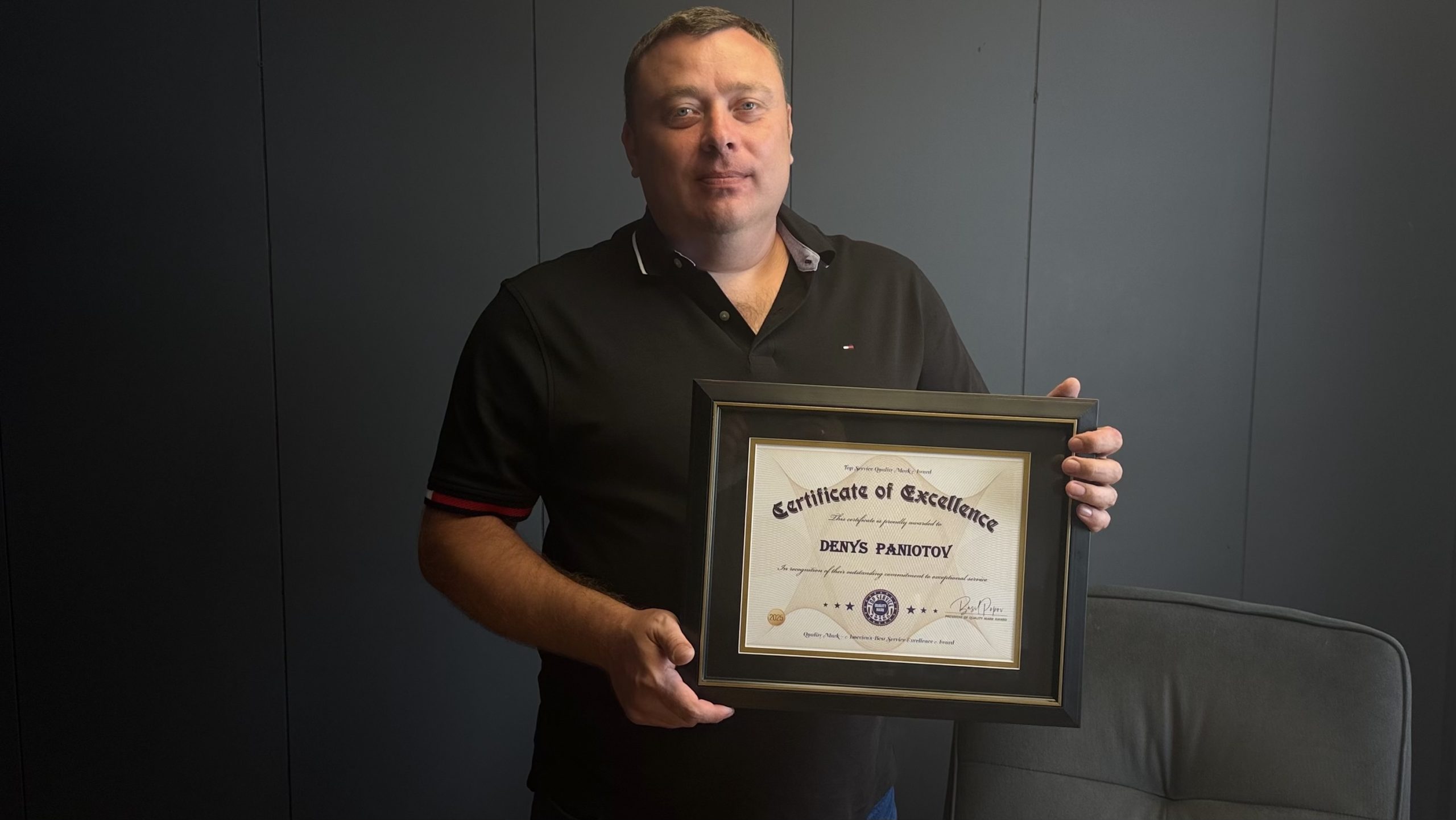
Between September 2025 and January 2026, Denys Paniotov, an automotive collision repair and refinishing specialist based in the United States, served as an Independent Industry Expert and Judge on the Expert Evaluation Commission of the Quality Mark Business Excellence Award in the category:
“Automotive Repair Technologies, Refinishing Systems & Operational Excellence in Collision and Detailing Services”
His appointment reflects a professional reality that’s easy to recognize: those who understand materials, processes, and outcomes at a granular level are often best positioned to evaluate the work of others.
Recognition of Technical and Industry Authority
An invitation to join an expert judging panel is, in many ways, a quiet but meaningful signal. It suggests that a professional’s experience is not only credible, but also transferable into structured evaluation.
In Paniotov’s case, that credibility comes from more than 15 years of hands-on experience across multiple markets — from Ukraine to the United States — combined with a deep technical understanding of automotive coatings, repair technologies, and process optimization.
His work has never been limited to execution alone. He has operated at the intersection of:
- technical craftsmanship
- operational management
- and methodological standardization
That combination matters. It’s one thing to repair vehicles. It’s another to understand why certain processes produce better outcomes — and how to evaluate them systematically.
Evaluating Excellence Beyond Surface-Level Claims
As part of the Expert Evaluation Commission, Paniotov reviewed nominations submitted by companies and professionals operating in automotive repair, refinishing technologies, and service operations.
This is where things get interesting.
Because in this industry, strong marketing can sometimes mask weak execution. A polished presentation doesn’t always reflect real operational quality. The role of a judge, then, is not just to read — but to interpret, question, and verify.
Evaluation was conducted based on structured criteria, including:
- quality and consistency of repair processes
- application of advanced paint and refinishing technologies
- operational efficiency and workflow optimization
- measurable business performance and customer outcomes
- contribution to industry standards and best practices
Each submission required careful analysis. Not quick impressions. Not assumptions. Actual comparison.
The Work Behind the Title “Expert Judge”
It’s easy to assume judging is symbolic. In reality, it’s quite the opposite.
During his tenure on the Commission, Paniotov:
- conducted independent, confidential assessments of competing nominations
- applied standardized evaluation frameworks to test claims of excellence
- provided expert scoring and analytical commentary
- contributed to the collective determination of category winners
There’s a certain discipline in doing this properly. You have to remain consistent, even when cases differ in scale or geography. A small, highly efficient operation can sometimes outperform a larger one — but only if you know what to look for.
Experience That Supports Judgment
Paniotov’s professional path explains why he was selected.
He began in technical roles and gradually moved into leadership positions, eventually managing regional operations in the automotive coatings and refinishing sector across multiple regions. Over time, he developed not only practical expertise but also a strategic view of how automotive service businesses scale and perform.
Later, his work expanded into:
- implementation of advanced European repair technologies
- optimization of operational workflows
- training and consulting within the industry
Since 2025, as Director of Boca Drive Collision Center in the United States, he has been responsible for operational management, quality control, and business development — a role that reinforces both technical and managerial credibility.
There’s also an academic layer to his profile. He is the author of a methodological manual on automotive repair systems and has contributed as a peer reviewer for scientific journals. Not every practitioner takes that extra step. But when they do, it tends to sharpen how they evaluate others.
Judging as a Marker of Professional Standing
In many industries, the ability to evaluate peers is considered a form of recognition in itself.
It signals trust. Not the loud kind. The quiet, professional kind.
Paniotov’s appointment indicates that his experience was considered sufficient — and appropriate — to assess submissions competing at a high level within the automotive sector.
And perhaps more importantly, that his judgment could be relied upon to remain objective.
Contributing to Industry Standards
There’s a broader effect to this kind of work.
Judges don’t just select winners. They help define what “good” actually looks like. Over time, those standards shape expectations across the industry.
In automotive repair, that has real consequences:
- better quality control
- more consistent processes
- higher customer trust
Through his participation in the 2025–2026 evaluation cycle, Denys Paniotov contributed to a system that rewards not appearance, but substance.
A Role Reserved for Practitioners Who Know the Work
There’s a certain pattern you notice over time. The strongest evaluators are rarely those who stand outside the industry. They’re the ones still inside it, dealing with real constraints, real materials, real deadlines.
Paniotov fits that pattern.
His role on the Expert Evaluation Commission was not ceremonial. It was functional, analytical, and — in its own way — consequential.
And if you think about it… that’s exactly how it should be.